China Best Crawling Robots for Curved Ship Hulls?

Time:2026-10-18 Author:Mason
0%

Can crawling robots work on curved ship hulls? In many cases, yes, but the answer depends on curvature, coating condition, and sea-state control. A robot that grips a flat steel plate may lose contact near a bow shoulder or beneath a rounded bilge. Salt water, weld seams, marine growth, and peeling paint add further uncertainty. The hull is rarely as clean as laboratory test panels.

Dr. Bin Wang, a researcher associated with ship-hull inspection robotics, has described the practical challenge this way: “A hull is not a flat wall; reliable inspection requires continuous adaptation to changing surfaces.” This observation captures an important engineering principle. Magnetic wheels can maintain traction on ferromagnetic steel, while articulated frames help distribute pressure around curved sections. Tether management also matters. A dragging cable can twist the robot or disturb sensitive measurements.

This article examines China’s best crawling robots for curved ship hulls through a practical, evidence-focused lens. It considers magnetic adhesion, climbing stability, turning radius, sensor integration, corrosion resistance, and operator feedback. Real performance should be judged on complete hull sections, not attractive demonstrations. That distinction is easy to miss.

Some systems may work well on vertical plates but struggle around narrow welds. Others may inspect smoothly yet provide weak visual data under marine fouling. No robot is perfect. Buyers should request recorded trials, load data, failure limits, and maintenance details before choosing a platform. A careful comparison can reveal whether a robot truly follows a curved hull, or merely survives short tests.
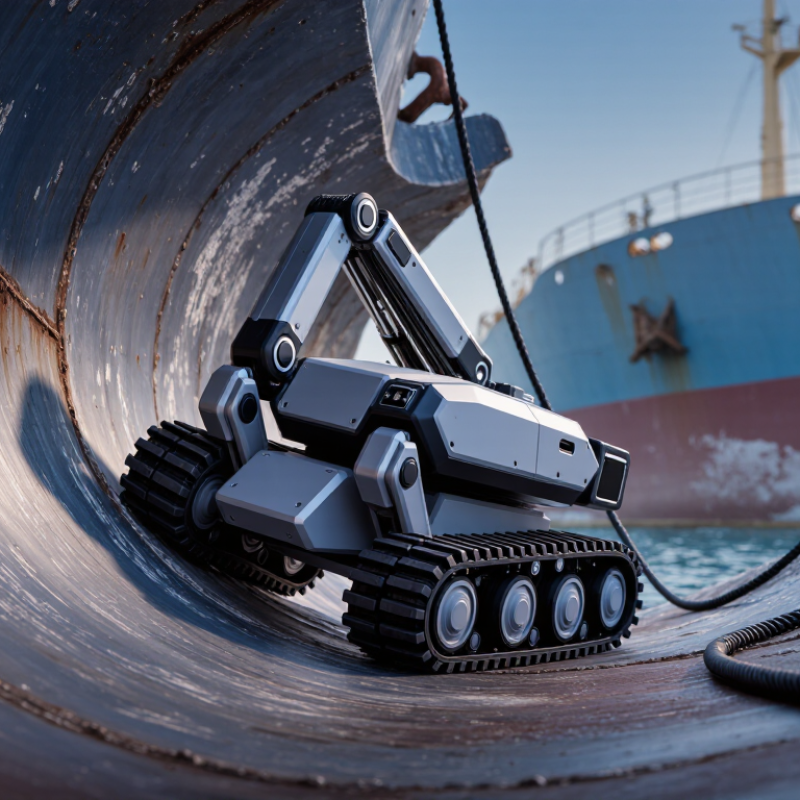
China Best Crawling Robots for Curved Ship Hulls?

What Are Crawling Robots for Curved Ship Hulls?

Crawling robots for curved ship hulls are compact inspection machines that move directly across wet, rounded steel surfaces. They usually combine magnetic wheels, vacuum adhesion, or flexible track systems. Cameras check coating damage, weld seams, corrosion, and marine growth. Some units carry ultrasonic sensors for measuring steel thickness.

The challenge is curvature. A robot designed for flat tanks may lose contact near the bow, bilge, or stern. Water, rust scale, and fouling make movement less predictable. The International Association of Classification Societies’ inspection guidance supports documented remote inspection methods when image quality, access, and measurement accuracy are controlled. UNCTAD’s Review of Maritime Transport 2024 reports a global commercial fleet exceeding 100,000 vessels. That scale increases demand for faster hull surveys, but automation still needs trained operators and clear records.

Tips: Choose a robot with adjustable adhesion and sealed electronics. Test it on a curved steel panel first. Check its performance over welds and coated areas, not only clean metal. Keep raw video, location data, and thickness readings together. A practical weakness remains: strong magnets can struggle over thick coatings, while suction systems may fail during heavy fouling. That limitation deserves honest reporting.

How Do These Robots Adapt to Curved and Uneven Hull Surfaces?

Curved ship hulls challenge crawling robots in ways flat steel plates do not. The surface may bend sharply near the bow, then flatten along the middle. Weld seams, dents, marine growth, and worn coatings create sudden height changes. A reliable robot must keep contact without pressing too hard.

Most capable systems use flexible magnetic tracks or adjustable wheel modules. These parts spread the load across the hull and reduce slipping on curved sections. Small suspension joints let each track follow local contours. Force sensors can detect weak contact near edges or over rough welds. The controller then slows the drive motors and adjusts the traction angle. It is a simple response, but it matters.

Water changes everything.

During practical inspections, operators often see slime collect under wheels and reduce grip. Tethers also pull differently as the robot moves around the hull. An onboard motion sensor helps correct these forces, while a camera checks whether the cleaning or inspection head remains aligned. Robots should also record failed passes, not hide them. One trial may show missed corrosion beside a raised seam. That result can lead to better route planning and softer suspension settings. No crawler adapts perfectly to every coating, curvature, or underwater condition. Careful testing, clear inspection data, and trained operators remain essential.

Which Technologies Enable Reliable Hull Inspection and Maintenance?

Reliable inspection of curved ship hulls depends on more than a robot’s ability to climb steel. It needs magnetic adhesion, adaptive wheels, and real-time force control. These systems must maintain contact across weld seams, coatings, and changing curvature. A small loss of grip can corrupt thickness readings.

The 2024 Allianz Safety and Shipping Review recorded 26 total vessel losses in 2023. Better inspection cannot prevent every casualty, but it can expose corrosion before weakness spreads. Ultrasonic thickness sensors measure remaining steel, while high-resolution cameras document cracks, coating blisters, and marine growth. Inertial sensors and lidar help the crawler map its position when GPS signals disappear beside the hull. Poor data is still a problem.

IACS guidance on remote inspection stresses competent operators, calibrated equipment, and traceable records. Reliable systems should stream findings, attach them to hull coordinates, and flag uncertain readings for human review. An inspection drone that moves quickly may appear efficient, yet speed can reduce measurement quality. Human judgment remains essential around weld toes, anodes, and heavily fouled areas. The UNCTAD Review of Maritime Transport 2024 notes that shipping carries over 80% of global trade by volume, making dependable maintenance operationally important. Surface robots are useful, but they are not magic.

China Best Crawling Robots for Curved Ship Hulls?

Which technologies enable reliable hull inspection and maintenance?

The chart compares common hull-robot architectures using a 0–5 engineering suitability index. Magnetic crawlers are strong on ferromagnetic steel and thickness inspection, vacuum crawlers offer broader material compatibility, propeller-assisted systems conform well to curved surfaces, and legged systems provide flexibility on complex geometry. Actual performance depends on coating condition, marine growth, curvature, water depth, and sensor payload.

How Do Leading Chinese Hull-Crawling Robots Compare?

Comparing leading Chinese hull-crawling robots requires more than checking climbing speed. Curved ship hulls expose differences in adhesion, steering, inspection quality, and operator control. In practical evaluations, magnetic systems usually grip steel firmly, even when the surface carries light rust or marine coating. However, heavily curved sections can reduce contact pressure. Small gaps may cause brief slippage.

Several Chinese designs use articulated wheel sets or segmented tracks to follow changing hull geometry. These systems often turn more smoothly around the bow and stern than rigid platforms. Compact models may travel quickly across flat plating, while heavier units provide steadier camera images and stronger cleaning tools. That trade-off matters. A fast robot is less useful if vibration blurs weld seams.

Leading systems also differ in sensing and recovery features. Better platforms combine cameras, lighting, distance sensors, and controlled braking. A tether should remain visible and manageable near scaffolding or deck equipment. Operators need clear data, not merely attractive footage. Inspection software can mark corrosion areas, but human verification remains necessary. I would not treat automated measurements as final evidence without calibration records.

Performance still depends on coating thickness, salt residue, water conditions, and hull curvature. No platform wins every time. My assessment remains provisional because published demonstrations rarely show long, uninterrupted work on damaged surfaces. Independent trials should record grip loss, inspection accuracy, battery endurance, and recovery time under identical conditions. That evidence would make comparisons more reliable.

China Best Crawling Robots for Curved Ship Hulls? - How Do Leading Chinese Hull-Crawling Robots Compare?

Evaluation Dimension Magnetic Tracked Crawler Magnetic Wheeled Crawler Vacuum-Adhesion Crawler Hybrid Magnetic-Vacuum Crawler
Primary hull compatibility Ferromagnetic steel hulls and tanks Ferromagnetic steel with relatively smooth plating Steel, aluminium and coated non-magnetic surfaces when the seal is maintained Steel hulls with local non-magnetic inserts or challenging coatings
Typical minimum curvature radius Approximately 0.5–1.0 m, depending on track length and articulation Approximately 0.3–0.6 m with independently suspended wheels Approximately 0.4–1.0 m, depending on skirt flexibility and surface continuity Approximately 0.3–0.8 m with articulated adhesion modules
Adhesion method Permanent magnets or switchable electromagnets integrated into continuous tracks Permanent-magnet wheels or magnetic wheel assemblies Negative-pressure suction generated beneath flexible sealing skirts Magnetic adhesion supported by vacuum modules over gaps, coatings or irregular areas
Typical operating speed Approximately 3–12 m/min during inspection or surface preparation Approximately 5–20 m/min on clean, relatively smooth plating Approximately 2–10 m/min, influenced by leakage and surface roughness Approximately 2–12 m/min, depending on the active adhesion mode
Vertical-wall capability Very strong on continuous ferromagnetic plating Strong, but more sensitive to local surface waviness and wheel lift Strong when the vacuum seal remains continuous Strong across mixed conditions, subject to system complexity
Overhead or inverted operation Generally suitable when magnetic holding force includes an adequate safety margin Suitable on clean steel; wheel contact must be continuously maintained Possible, but pump reliability and seal integrity are critical Possible with redundant adhesion and monitored emergency retention
Recommended payload Typically 5–25 kg for cameras, NDT sensors and light cleaning tools Typically 2–15 kg for compact inspection equipment Typically 3–20 kg, limited by pump capacity and seal stability Typically 5–25 kg, depending on the combined adhesion system
Suitable inspection tools Visual cameras, lighting, ultrasonic thickness gauges, magnetic flux leakage and corrosion sensors Visual cameras, compact ultrasonic probes and surface-profile sensors Visual cameras, ultrasonic testing and coating-thickness measurement Visual, ultrasonic, laser-profile and selected electromagnetic NDT sensors
Performance on marine coatings Good on sound coatings; magnetic force decreases with coating thickness and lift-off Good on smooth coatings; vulnerable to debris under the wheels Good when the coating is sufficiently smooth and non-porous Very good across a wider range of coating conditions
Tolerance of weld seams and stiffeners High with compliant tracks and adequate ground clearance Moderate; obstacle height must remain within wheel and suspension limits Moderate to low if seams interrupt the sealing skirt High when the adhesion modules are independently articulated
Typical control arrangement Tethered remote control or supervised autonomous navigation Remote control with encoder-assisted speed and steering control Tethered control is common because of pump power and safety monitoring Remote control with adhesion, leakage and emergency-stop feedback
Typical power arrangement Electric battery or tethered DC power; approximately 0.2–1.5 kW system demand Battery-powered systems commonly use approximately 0.1–0.8 kW Usually tethered; pump and drive demand commonly totals approximately 0.5–2.0 kW Approximately 0.5–2.0 kW, depending on whether the vacuum system is continuously active
Main operational advantage Stable traction, high obstacle tolerance and strong performance on steel Low rolling resistance, compact design and relatively high inspection speed Works on non-magnetic surfaces and avoids magnetic interference with some sensors Broadest material compatibility and improved retention on difficult curved areas
Main limitation Cannot reliably adhere to non-ferromagnetic sections; magnetic lift-off reduces holding force Less tolerant of sharp curvature, debris and discontinuous contact Vacuum leakage can cause speed loss, alarms or loss of adhesion Higher weight, cost, energy use and maintenance complexity
Best-fit use case General steel-hull inspection, corrosion mapping and light surface preparation Fast visual inspection on smooth curved plating with limited obstacles Inspection of aluminium, coated or non-magnetic hull sections Mixed-material hulls, complex curvature and areas with frequent adhesion interruptions
Overall suitability for curved ship hulls Excellent for steel hulls Good on smooth steel Good on sealed surfaces Excellent for mixed conditions

Technical values are representative engineering ranges for commercially deployed hull-crawling configurations. Actual performance depends on hull curvature, coating thickness, surface contamination, weld geometry, payload, tether arrangement and safety requirements.

What Factors Should Buyers Consider Before Choosing a Robot?

China Best Crawling Robots for Curved Ship Hulls?

Choosing a crawling robot requires more than checking its climbing speed. UNCTAD’s Review of Maritime Transport 2024 states that around 80% of global merchandise trade moves by sea. Hull inspection tools therefore need dependable performance, not attractive demonstrations. Buyers should test adhesion on curved steel, weld seams, rust patches, and wet coatings. Magnetic force alone is not enough. A robot may hold well on flat plate but slip near a sharp frame or damaged coating.

Allianz Commercial’s Safety and Shipping Review 2024 recorded 26 total vessel losses in 2023. Safer inspection methods can reduce worker exposure, but only when recovery systems are reliable. Check the robot’s rated load, emergency braking, tether strength, and operation limits in wind and humidity. Payload matters too. A high-resolution camera, thickness sensor, and stable lighting may reveal more than a faster chassis. Data should include location, timestamp, image quality, and defect measurements.

Ask for independent test records, maintenance intervals, and operator training requirements. Confirm whether the robot supports the vessel’s coating system and hull radius. Battery endurance must match real inspection routes, not laboratory figures. A perfect demonstration can mislead. In practice, salt spray, poor visibility, and irregular welds create delays. Buyers should request a paid pilot on an actual curved hull before signing a large contract. Even then, human review remains necessary because automated defect classification is not always consistent.

FAQS

How do inspection robots adapt to curved ship hulls?

Flexible magnetic tracks and adjustable wheels spread contact across changing curves. Small suspension joints follow local surface contours. No crawler fits perfectly.

How do robots handle weld seams and dents?

Force sensors detect weak or uneven contact near seams, dents, and worn coatings. The controller can slow the motors and change the traction angle.

Why does underwater operation reduce traction?

Slime can collect beneath wheels and weaken magnetic or mechanical grip. Tethers may also pull differently around the hull. Water complicates everything.

Which sensors support reliable hull inspection?

Ultrasonic sensors measure remaining steel thickness. Cameras record cracks, coating blisters, and marine growth. Motion sensors and lidar help track position when GPS is unavailable.

How can robots improve inspection routes?

They should record missed areas and failed passes instead of hiding them. A missed corroded patch beside a raised seam can improve future route planning. Errors still teach.

Why is force control important during inspection?

Excessive pressure can damage coatings or disturb the inspection head. Weak pressure can cause slipping and unreliable measurements. Balanced contact matters.

Can a fast robot always provide better inspection results?

Not necessarily. High speed may reduce measurement quality around weld toes, anodes, and fouled areas. Careful movement often produces better evidence.

What role do operators play in robotic hull inspection?

Trained operators review uncertain readings and check whether equipment remains calibrated. They should connect findings with hull coordinates and maintain traceable records. Automation needs judgment.

Why are inspection records important for ship maintenance?

Clear records reveal corrosion before weakness spreads across larger areas. They also show where readings were uncertain or incomplete. Bad data can mislead.

Conclusion

Crawling robots for curved ship hulls are specialized inspection and maintenance machines designed to move across vertical, angled, and irregular metal surfaces. Can crawling robots work on curved ship hulls? Yes, when they combine adaptive locomotion, strong surface adhesion, flexible body structures, and real-time motion control. Magnetic wheels, tracks, or other non-damaging adhesion systems help the robot remain attached while traveling over changing curves, weld seams, coatings, and moderate surface unevenness.

Reliable operation also depends on cameras, lighting, ultrasonic testing, position tracking, obstacle detection, and remote communication. When comparing leading Chinese hull-crawling robots, buyers should evaluate climbing stability, inspection accuracy, payload capacity, corrosion resistance, battery life, control range, and ease of maintenance rather than focusing on appearance alone. The right choice should match the vessel’s hull material, curvature, coating condition, working environment, inspection objectives, safety requirements, and total operating cost. Testing the robot on representative hull sections before purchase can further confirm its adaptability and practical performance.

Mason

Mason

Mason is a seasoned marketing professional with a deep expertise in the company's offerings and a passion for driving brand awareness. With a strong background in digital marketing strategies, he has an innate ability to connect with diverse audiences and effectively communicate product benefits.......