Integrating artificial intelligence into a welding robot does not mean replacing the entire production cell. It means improving decisions inside a system that already works. The practical question is: How to integrate AI with existing welding robots without disrupting qualified procedures, operator routines, or production targets?
A useful starting point involves reviewing real welding data. Examine arc voltage, wire speed, travel speed, torch angles, weld appearance, and rework records. Then, connect AI tools to selected control points. These may include seam tracking, weld defect detection, adaptive parameter adjustment, predictive maintenance, and production monitoring. A camera mounted near the torch can identify joint variation, while sensors can detect unusual vibration or contact-tip wear. Small improvements matter.
Dr. John C. Lippold, a recognized welding metallurgy expert, has emphasized, “Successful automation begins with understanding the welding process, not simply adding technology.” That principle should guide every integration decision. AI should support qualified welders and engineers, not hide weak procedures behind impressive software. A model may perform well during testing, yet fail when reflective steel, smoke, or poor lighting changes the image. That is an uncomfortable reality.
The seven methods in this guide focus on practical integration, measurable results, and controlled risk. Each method considers existing robot interfaces, data quality, operator training, and validation requirements. Some factories may need only better inspection. Others may benefit from closed-loop parameter control. There is no universal solution. The strongest plan starts modestly, records failures honestly, and expands only after the evidence supports it.
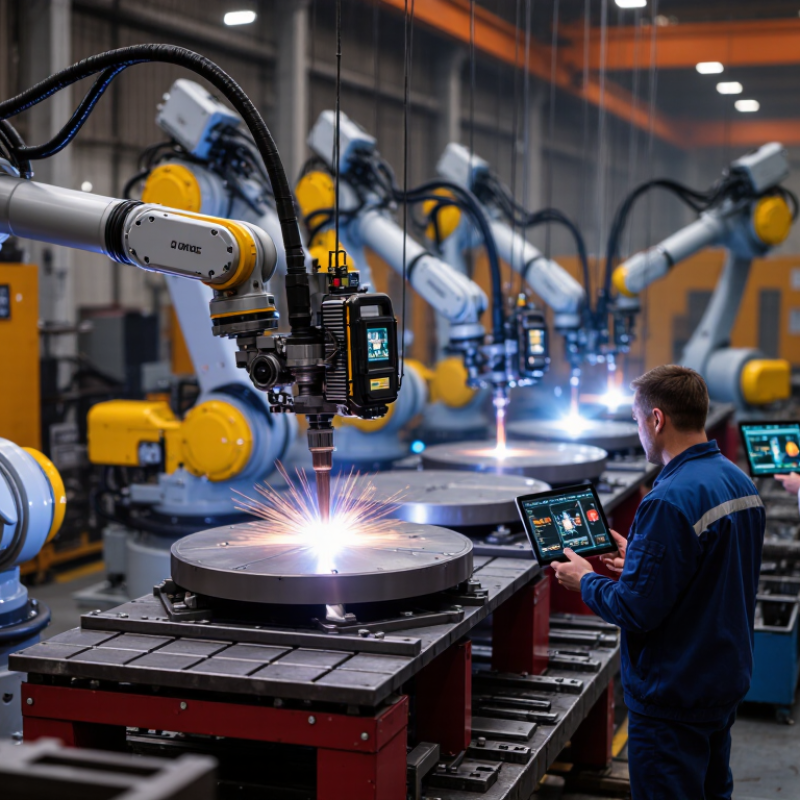
Assessing Welding Robots for AI Integration
Before adding AI, assess the robot’s real condition. Check controller age, communication protocols, teach pendant access, sensor ports, and maintenance records. A newer model may still lack usable production data. An older robot may support integration through an industrial gateway. The deciding factor is not appearance. It is data access.
The International Federation of Robotics reported 541,302 industrial robot installations worldwide in 2023. This expanding installed base creates a practical opportunity for AI upgrades, rather than complete replacement. Evaluate weld current, voltage, wire speed, travel speed, torch angle, and defect history. These signals can support adaptive parameter control and predictive maintenance. However, inconsistent fixturing can confuse even a strong model. AI cannot repair poor grounding or a misaligned torch. That remains an uncomfortable limitation.
Tips: Run a small pilot on one weld cell. Compare defect rate, rework hours, arc-on time, and false alarms for four weeks. The World Economic Forum’s Future of Jobs Report 2025 identifies AI and information processing as major business transformation drivers, but welding teams still need validation skills. Keep operators involved. Review edge cases manually. Protect production data. A technically impressive system may fail when lighting changes, spatter covers a camera, or material thickness varies. Measure twice. Integrate once.
| No. | AI Integration Method | Primary Robot or Process Data | Typical AI Function | Required Components and Interfaces | Expected Response Time | Operational Benefits | Main Limitations and Risks | Integration Readiness |
|---|---|---|---|---|---|---|---|---|
| 1 | Real-Time Weld Seam Tracking | Laser profile Joint position Robot pose Weld speed | Computer vision estimates joint location and sends corrective path offsets to keep the torch aligned with the seam. | 2D or 3D sensor, industrial computer, robot-controller interface, calibrated sensor-to-tool transform, and protected sensor mounting. | Usually tens to hundreds of milliseconds | Compensates for fixture variation, part distortion, and small seam-position errors; reduces dependence on highly precise fixturing. | Sensitive to spatter, smoke, reflective surfaces, poor lighting, occlusion, and incorrect calibration. Safety limits are required for path corrections. | |
| 2 | AI-Based Weld Parameter Optimization | Current Voltage Wire feed speed Travel speed Gas flow | Predicts suitable parameter windows or recommends adjustments to improve penetration, bead geometry, and arc stability. | Weld-power data interface, material and joint database, data historian, model-training environment, and operator approval workflow. | Seconds to minutes for recommendations; slower for offline optimization | Shortens parameter-development cycles, supports repeatable recipes, and helps identify stable operating ranges for recurring joint types. | Recommendations are only as reliable as the training data. Material thickness, joint preparation, shielding conditions, and process changes can reduce model accuracy. | |
| 3 | Vision-Based Part and Joint Inspection | Images Bead profile Joint geometry Surface condition | Detects visible defects such as excessive spatter, underfill, irregular bead shape, lack of continuity, and incorrect part presence. | Industrial camera or 3D scanner, controlled illumination, edge-computing device, inspection software, and traceability database. | Milliseconds to several seconds per inspection | Provides consistent inspection criteria, enables in-line screening, and creates digital evidence linked to part or weld identifiers. | Surface inspection cannot reliably confirm internal weld integrity. False positives may occur because of changing reflectivity, contamination, or lighting. | |
| 4 | Predictive Maintenance for Robot and Welding Equipment | Motor current Drive alarms Cycle time Temperature Service history | Detects abnormal operating patterns and estimates the likelihood of component degradation or an impending equipment fault. | Controller logs, drive and motor signals, weld-power data, maintenance records, time synchronization, and secure data storage. | Minutes to hours for risk alerts | Supports condition-based maintenance, reduces unplanned downtime, and helps prioritize inspection of torches, liners, feeders, cables, motors, and reducers. | Rare failures provide limited examples for training. Maintenance records must be accurate, and alerts require verification before equipment is taken offline. | |
| 5 | Adaptive Control Using Arc and Process Signals | Arc current Arc voltage Wire feed Acoustic signal Thermal data | Identifies process instability and adjusts selected parameters within predefined limits while welding is in progress. | High-frequency signal acquisition, deterministic control interface, validated control logic, real-time computing, and hard safety boundaries. | Sub-millisecond to tens of milliseconds, depending on the control loop | Helps maintain arc stability despite moderate changes in fit-up, thermal conditions, or consumable behavior. | Requires high-quality synchronized signals and rigorous validation. Excessive or poorly tuned corrections can create defects or unstable arc behavior. | |
| 6 | Digital Twin and Offline Process Simulation | CAD geometry Robot programs Tool paths Cycle data | Simulates reachability, collision risk, torch orientation, sequence planning, and estimated cycle time before deployment on the production cell. | Robot and cell models, CAD or neutral geometry files, controller program format, calibrated tooling data, and production feedback. | Minutes to hours before production | Reduces offline programming effort, exposes reach and collision problems earlier, and supports faster introduction of new weldments. | Simulation accuracy depends on the quality of robot, fixture, tooling, and process models. Real-world cable behavior, distortion, and access conditions may differ. | |
| 7 | Natural-Language Production and Knowledge Assistant | Weld procedures Alarm history Work instructions Quality records | Retrieves approved procedures, explains alarms, summarizes production events, and guides technicians through documented troubleshooting steps. | Searchable document repository, structured machine data, access control, audit logging, and a read-only connection to operational systems during initial deployment. | Seconds for responses | Improves access to process knowledge, supports operator training, and reduces time spent searching manuals and historical records. | Generated answers require verification. Outdated documents, weak permissions, or unrestricted control access can create safety, quality, and cybersecurity risks. |
Check the controller age, communication protocols, sensor ports, teach pendant access, and maintenance records. Data access matters most. An older robot may still work with an industrial gateway. Appearance can mislead.
Useful signals include weld current, voltage, wire speed, travel speed, torch angle, and defect history. These readings can reveal unstable arcs and gradual torch misalignment. Poor grounding still defeats AI.
No. AI cannot correct poor grounding, inconsistent fixturing, or a misaligned torch. These physical problems can confuse even a capable model. Check the setup first.
Start with one welding cell and run the pilot for four weeks. Compare defect rates, rework hours, arc-on time, and false alarms. Review unusual cases manually. A small trial exposes weaknesses earlier.
Consider current, voltage, temperature, vibration, and wire-feed sensors near the welding cell. A camera can inspect bead shape and surface defects after cooling. Calibrate sensors before each trial. Compare readings with a handheld meter.
Record weld settings, operator adjustments, alarms, downtime, inspection results, and synchronized sensor readings. Use consistent formats and timestamps. Missing or duplicate records reduce confidence. Clean data helps.
Capture clean and defective welds under real production conditions. Include beads, joints, spatter, undercut, porosity, and incomplete fusion. Stable camera angles and consistent lighting are essential. Smoke and reflections can still create false results.
No. AI should support decisions, not silently control safety-critical actions. Send uncertain images to trained personnel. Keep audit records of images, decisions, and corrections. Human judgment remains necessary.
Monitor false alarms weekly as wire, lighting, and joint geometry change. Retrain with verified new samples, not every rejected image. One early dashboard was too complicated. Simpler displays worked better.
Integrating AI with existing welding robots can improve quality, productivity, and decision-making without requiring a complete replacement of current equipment. The process begins by assessing each robot’s controller, software compatibility, communication interfaces, and operational limitations. Next, upgraded sensors can capture weld images, temperatures, movement data, and production conditions, creating a reliable foundation for analysis. A structured data collection system also helps identify recurring problems and establish performance benchmarks.
The question of How to integrate AI with existing welding robots can be answered through practical applications such as vision-based inspection, automatic defect detection, and predictive analytics for welding parameter optimization. AI can recognize inconsistencies, recommend adjustments, and anticipate maintenance needs before failures occur. To ensure long-term success, improvements should be introduced safely, tested in stages, monitored by skilled personnel, and scaled gradually. Continuous feedback and regular model updates allow the system to become more accurate while preserving stable production and responsible robot operation.

 Mobo Robot