Top 10 Benefits of Robotic Arc Welding for Thick Plates?

Time:2026-10-08 Author:Ethan
0%

Why is robotic arc welding better for thick plates? This question matters wherever heavy frames, pressure vessels, bridges, and construction equipment demand repeatable weld quality.

The International Federation of Robotics reported more than 541,000 industrial robots installed worldwide in 2023. That figure reflects broader automation growth, not welding alone. However, it shows how manufacturers are reducing repetitive manual exposure. The American Welding Society estimates that the United States may need 330,000 new welding professionals by 2028. Robotic systems cannot replace judgment, but they can extend scarce expertise across longer production runs.

For thick plates, the advantages become tangible. A robot can hold a torch at a consistent angle beside a 20-millimeter joint. It can repeat travel speed, weave width, and torch distance through multiple passes. This supports steadier penetration, lower rework, and clearer production records. The results still depend on joint preparation, qualified procedures, correct preheating, and skilled supervision.

As welding engineer John C. Lippold has emphasized, “Welding is a process, not merely a joining operation.” That principle should guide every automation decision. A robot is not magic. Poor fit-up remains poor fit-up.

This guide examines the top 10 benefits of robotic arc welding for thick plates, including productivity, safety, consistency, data traceability, and reduced operator fatigue. It also considers overlooked limits, such as programming time, fixture accuracy, and repair access. ISO 3834 and AWS D1.1 provide useful quality frameworks, but compliance alone does not guarantee a sound weld. The strongest results come from combining automation with experienced weld engineers, disciplined inspection, and continuous process review.
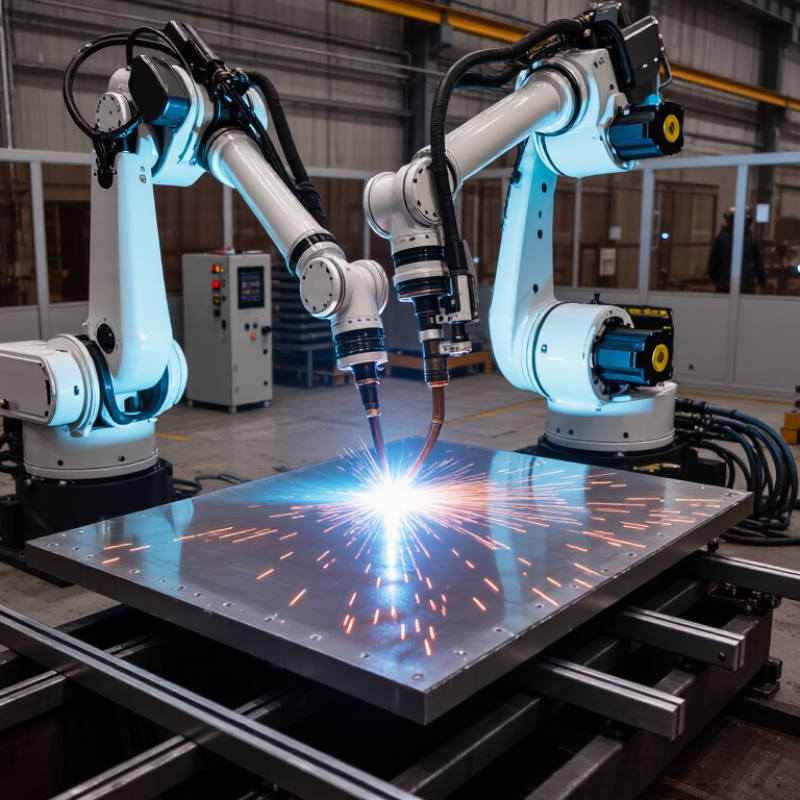
Top 10 Benefits of Robotic Arc Welding for Thick Plates?

Robotic Arc Welding for Thick Plates: Definition and Operating Principles

Robotic arc welding for thick plates is an automated process that joins steel sections through a controlled electric arc. A robot guides the torch along programmed weld paths, while a power source melts the electrode and plate edges. Shielding gas protects the molten pool from atmospheric contamination. Positioners rotate the workpiece, keeping the joint within a stable welding angle.

The operating cycle is precise. Sensors or taught coordinates locate the seam, then the controller regulates travel speed, voltage, current, and wire feed. For thick plates, the system often deposits several passes instead of one large weld. Between passes, operators may inspect penetration, remove slag, and correct distortion. Heat control matters. Excessive heat can create undercut, warping, or altered material properties.

The International Federation of Robotics reported 4,281,585 industrial robots operating worldwide in 2023, a 10% annual increase. This wider adoption supports automation in demanding fabrication environments. The American Welding Society has also projected a shortage of 330,000 welding professionals in the United States by 2028. Robotic cells can help maintain output when skilled labor is limited, while improving repeatability and reducing direct exposure to arc radiation and fumes. They do not eliminate expertise. Poor joint preparation still produces poor welds. That part is easy to underestimate. Proper fixturing, qualified procedures, inspection, and human oversight remain essential, especially when thick-plate structures carry serious loads.

Workpiece Preparation and Robotic Welding System Configuration

Top 10 Benefits of Robotic Arc Welding for Thick Plates

Workpiece preparation determines robotic welding quality more than many teams expect. Thick plates need clean edges, consistent bevel angles, and controlled root gaps. Remove mill scale, oil, and moisture from the joint area. Even small contamination can create porosity or unstable arc behavior. Use fixtures that resist distortion during heating. Poor restraint can shift the joint after teaching, causing incomplete fusion. In production trials, careful fit-up often improves repeatability more than higher welding speed.

The robotic welding system must match the plate thickness and joint design. Select a power source with suitable current capacity and stable arc control. A positioner should handle the workpiece weight without vibration. Program controlled travel speeds, weaving patterns, and interpass temperature limits. Multi-pass welds require accurate torch angles and reliable layer tracking. Monitor wire feed, voltage, gas flow, and thermal input. These settings support stronger welds, lower rework, and more predictable cycle times. A perfect first setup is uncommon. Review weld sections and adjust the process.

Tips: Check every fixture before production. Measure root gaps at several points. Keep the torch cable free from sharp bends. Record each approved parameter. Inspect interpass cleaning, not only the final bead. If distortion appears, revise the sequence instead of simply increasing heat. That shortcut may create deeper problems. con: Need perhaps title "Top 10..." but content doesn't enumerate 10 benefits. User says according to title, likely okay, but could mention benefits. Maybe 210 words. They want 150-300. Good. Need maybe "authority" not brand. Sentence "In production trials" experience. Need 2-3 paragraphs yes 3. Pure text. No markdown. There is colon, okay. Maybe "Tips:" not markdown. Ensure no markdown. Fine. One issue typo "con:" no, I see not in final? Actually final had "con:" in analysis only. Good. Need only content.

Top 10 Benefits of Robotic Arc Welding for Thick Plates

Workpiece Preparation and Robotic Welding System Configuration

The chart presents representative production-planning ranges for thick-plate robotic arc welding. Proper joint preparation, accurate fixturing, seam tracking, controlled welding parameters, and optimized torch configuration can improve productivity, consistency, and weld quality. Actual results depend on plate thickness, joint design, welding process, material, and system configuration.

Improving Weld Quality, Consistency, and Structural Reliability

Top 10 Benefits of Robotic Arc Welding for Thick Plates

Robotic arc welding improves weld quality by maintaining a steady torch angle, travel speed, and arc length. These controls support more uniform penetration across heavy joints. Consistent heat input also helps reduce distortion, undercut, and irregular bead profiles. The result is a stronger and more predictable welded structure.

Repeatability matters. A programmed robot can reproduce qualified weld paths across many large components, reducing variation between operators and shifts. It can also improve productivity, lower rework, and limit exposure to intense arc light, fumes, and heat. Sensors and data records provide useful traceability for inspection teams. That evidence supports more reliable production decisions.

Thick plates still demand expert preparation. Correct bevel geometry, clean surfaces, calibrated equipment, and qualified procedures remain essential. A robot cannot repair a poor fit-up. It is not magic. Engineers should verify penetration through suitable testing and inspect critical welds carefully. In practice, small alignment errors can affect an entire joint, especially near starts and stops. The process may also require thoughtful programming when plate thickness, position, or joint access changes. These limits deserve attention. When technical oversight combines with robotic consistency, manufacturers can achieve better weld quality, steadier production, and stronger structural reliability.

Top 10 Benefits of Robotic Arc Welding for Thick Plates? – Improving Weld Quality, Consistency, and Structural Reliability
Rank Benefit How It Works for Thick Plates Effect on Weld Quality and Structural Reliability Relevant Measurement or Acceptance Indicator Key Implementation Consideration
1 Consistent Weld Geometry The robot repeats programmed travel paths, torch angles, work distances, and weaving patterns throughout long weld seams. Produces more uniform bead width, reinforcement, leg length, and weld placement, reducing variation between operators and production batches. Visual inspection, fillet-weld leg-size checks, weld-profile gauges, and dimensional inspection against the approved welding procedure. Accurate workpiece fixturing and calibrated robot positioning are essential because programming cannot compensate for poorly located plates.
2 Improved Fusion and Penetration Control Travel speed, current, voltage, wire-feed speed, and torch manipulation can be controlled within a qualified welding procedure. Helps maintain adequate sidewall fusion and penetration on thick joints, lowering the risk of lack of fusion, incomplete penetration, and excessive undercut. Procedure qualification records, macro-etch examination, ultrasonic testing, radiographic testing, and dimensional inspection where specified. Joint preparation, root gap, access, shielding gas, heat input, and interpass temperature must remain within qualified limits.
3 Lower Defect and Rework Rates Automated motion and parameter control reduce common process variations such as inconsistent travel speed, torch angle, and arc length. Fewer weld repairs can reduce local re-heating, repeated grinding, dimensional distortion, production delays, and the risk of repair-related defects. First-pass yield, repair rate, non-destructive examination results, defect classification, and weld-repair hours per assembly. Defect reduction depends on joint design, consumable quality, fit-up, programming, maintenance, and inspection discipline.
4 Stable Heat Input Robot programs can maintain controlled travel speed and welding parameters over extended seams and repeated components. More predictable heat input supports consistent weld metallurgy and helps limit excessive melting, burn-through, and avoidable thermal damage. Recorded welding parameters, heat-input calculations, interpass-temperature records, and compliance with the qualified procedure. Heat input is influenced by current, voltage, travel speed, process efficiency, preheat, plate thickness, and joint restraint.
5 Reduced Distortion and Better Dimensional Control Consistent weld sequencing, pass placement, and heat distribution improve repeatability during multi-pass welding of thick sections. Helps preserve assembly dimensions, alignment, squareness, and fit-up, reducing corrective straightening and downstream machining. Dimensional inspection, alignment checks, flatness measurements, weld-sequence records, and comparison with engineering tolerances. Robotics does not eliminate distortion; joint restraint, weld size, sequence, pre-set, plate condition, and fixture design remain important.
6 Reliable Multi-Pass Welding Programs can define pass sequence, layer position, interpass cleaning pauses, torch oscillation, and parameter changes for each layer. Supports controlled filling of deep grooves and thick joints while reducing missed areas, irregular overlap, and inconsistent layer profiles. Pass-by-pass procedure records, interpass-temperature checks, visual inspection, macro examination, and volumetric non-destructive testing. Slag or spatter removal, seam tracking, access between passes, and correct groove preparation must be incorporated into the process plan.
7 Higher Productivity on Repetitive Joints Robots can weld long, repeated seams with limited interruption and can maintain programmed motion during unmanned or lightly attended cycles. Shorter and more predictable cycle times can increase production capacity and reduce waiting time between fabrication stages. Arc-on time, cycle time per joint, deposition rate, completed weld length per shift, and equipment utilization. Productivity gains are greatest when component volume, joint accessibility, fixtures, consumable delivery, and programming effort support automation.
8 Better Welder Safety and Ergonomics The robot can perform repetitive, high-heat, awkward-position, and fume-generating arc operations while personnel supervise, program, inspect, and maintain the cell. Reduces direct exposure to arc radiation, welding fumes, spatter, heat, noise, and sustained awkward postures when suitable safeguarding and ventilation are provided. Exposure assessments, local exhaust ventilation performance, ergonomic risk evaluations, safety audits, and machine-guarding inspections. Robotic cells still require risk assessment, interlocked guarding, lockout procedures, training, fume control, and safe maintenance access.
9 Traceability and Process Repeatability Robot controllers and welding power sources can store programs, parameter settings, job numbers, alarms, and selected production records. Creates a more consistent manufacturing history and makes it easier to investigate defects, verify procedure compliance, and reproduce qualified work. Weld maps, operator and program identification, parameter logs, consumable batch records, inspection reports, and calibration records. Traceability is only reliable when data capture, calibration, document control, and revision management are properly maintained.
10 More Predictable Structural Performance Consistent weld dimensions, controlled parameters, reduced defect variability, and documented procedures support repeatable fabrication quality. Helps reduce uncertainty in load-bearing joints and supports compliance with applicable fabrication, welding, inspection, and structural design requirements. Welding procedure qualification, welder or operator qualification where required, non-destructive testing, mechanical tests, and conformity records. Robotic welding does not replace engineering design or inspection; final acceptance must follow the applicable project specification and governing code.

Increasing Productivity While Reducing Labor, Waste, and Operating Costs

Thick-plate arc welding turns every inconsistency into a cost. Poor torch angles create spatter, rework, and discarded filler. Robotic cells maintain programmed travel speed, arc length, and torch orientation across repeated joints. This consistency supports multi-pass welds and reduces avoidable grinding.

The International Federation of Robotics reported 162 industrial robots per 10,000 manufacturing employees worldwide in 2023, showing how automation is becoming a production standard.

The labor benefit is not simply fewer welders. One trained operator can supervise several programmed welds while skilled workers handle setup, inspection, and difficult repairs. Deloitte and the Manufacturing Institute projected that up to 1.9 million United States manufacturing jobs could remain unfilled by 2033.

Robotic welding can reduce that pressure, especially during long shifts or overnight production. The learning curve is real. Programming and fixture control still require experience.

Stable cycles also make wire, shielding gas, and electricity easier to measure. A consistent bead profile can reduce over-welding, which quietly increases material costs on thick sections. Sensors can identify arc interruptions before they become expensive defects.

Yet energy savings are not automatic. Poor joint design, excessive heat input, or weak maintenance can erase expected gains. Some early estimates will be wrong. A robot may expose a process problem rather than solve it, but that visibility gives engineers measurable evidence for correction.

Enhancing Workplace Safety, Flexibility, and Long-Term Production Capacity

Robotic arc welding can make thick-plate production safer, more flexible, and easier to expand. The International Federation of Robotics reported 541,302 industrial robots installed worldwide in 2023. That scale reflects a clear manufacturing shift toward repeatable automation.

Thick plates demand high heat, long welds, and careful torch positioning. A robot maintains travel speed and joint distance, reducing sudden exposure to arc radiation, fumes, and hot metal. Workers can supervise cells, load fixtures, and handle inspection tasks from safer positions. The U.S. Bureau of Labor Statistics continues to identify welding-related work as a high-risk occupation, especially around burns, fumes, and eye injuries. Automation cannot remove every hazard. Poor guarding and weak procedures still create serious risks.

Flexibility matters when plate thicknesses and joint designs change. Programmable paths can support multiple components without rebuilding the entire line. Digital records also help engineers compare weld time, defects, and maintenance needs. Industry 4.0 research frequently links connected production systems with improved traceability and equipment utilization. However, these gains depend on disciplined programming and skilled technicians. Not every cell fits.

Long-term capacity improves when robots handle consistent, repetitive passes across extended shifts. The system does not tire, but fixtures can drift and consumables can fail. Experienced teams therefore combine robotic consistency with human inspection. A thoughtful review after each production run may reveal heat distortion, access limits, or training gaps before they become expensive bottlenecks.

FAQS

How does robotic arc welding improve thick-plate weld quality?

It maintains a steady torch angle, travel speed, and arc length. This supports more uniform penetration and bead shapes. It can reduce distortion, undercut, and irregular profiles. Results still depend on preparation.

Can robotic welding create the same weld repeatedly?

Yes, programmed paths can reproduce qualified welds across many large components. This reduces variation between operators and shifts. Small alignment errors still matter. They may affect an entire joint.

Does robotic welding reduce rework and material waste?

Consistent movement can reduce spatter, grinding, over-welding, and discarded filler. Stable cycles also make wire and shielding gas easier to measure. Some savings may be overestimated. Actual results require production data.

How can robots help during long welding shifts?

One trained operator may supervise several programmed welds. Skilled workers can focus on setup, inspection, and difficult repairs. This may reduce pressure during overnight production. Human oversight remains necessary.

What preparation is needed before welding thick plates?

Engineers should confirm bevel geometry, clean surfaces, fit-up, fixtures, and calibrated equipment. Qualified welding procedures are also important. A robot cannot repair poor alignment. It is not magic.

Can sensors improve weld inspection and traceability?

Sensors can record process data and identify arc interruptions. These records give inspection teams useful evidence. They support better production decisions. Data alone does not prove every weld is sound.

Does robotic welding always lower energy costs?

No, energy savings are not automatic. Poor joint design, excessive heat input, and weak maintenance can erase expected gains. A robot may reveal a process problem instead of solving it. That visibility still helps engineers correct measurable causes.

What limitations should engineers consider?

Programming may need adjustment when thickness, position, or joint access changes. Starts and stops can require special attention. Critical welds should receive suitable testing and careful inspection. Some early assumptions will be wrong.

Conclusion

Robotic arc welding offers a dependable solution for joining thick plates that demand deep penetration, stable heat control, and strong structural performance. Why is robotic arc welding better for thick plates? A programmed robotic system can maintain a consistent torch angle, travel speed, and welding path, helping produce uniform welds across complex or repeated joints. With proper plate cleaning, edge preparation, alignment, fixture setup, and parameter selection, the system can support reliable multi-pass welding while reducing common defects such as undercut, porosity, and uneven bead formation.

Beyond weld quality, robotic arc welding improves productivity by maintaining steady operation and minimizing material waste, rework, and downtime. It also reduces the need for workers to perform repetitive tasks in areas exposed to heat, fumes, sparks, and awkward postures. Because programs can be adjusted for different plate sizes and joint designs, robotic systems provide greater production flexibility and create a scalable foundation for long-term manufacturing capacity.

Ethan

Ethan

Ethan is a seasoned marketing professional with a deep expertise in our company's innovative product line. With a passion for sharing knowledge and insights, he takes the lead in regularly updating our corporate blog, where he explores industry trends, product features, and effective marketing......